Executive Summary
Local edge intelligence took a quantum leap forward as Mistral AI dropped the open-weight Voxtral model family, enabling sub-200ms audio transcription directly on laptops and phones. In parallel, Deepgram released Nova-3 with groundbreaking domain adaptability and enhanced multi-speaker diarization.
The Shift to Sovereign On-Device Speech Processing
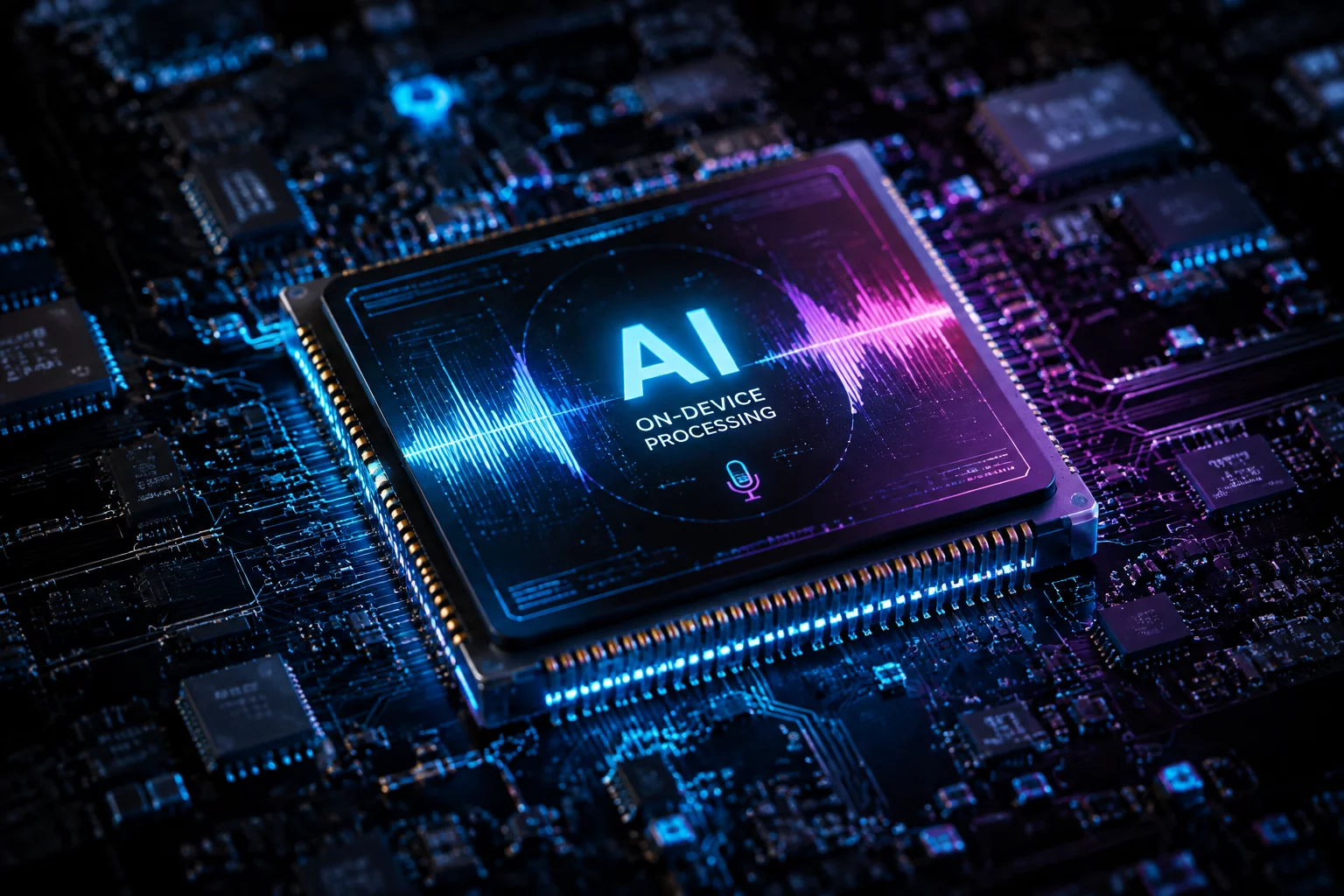
Processing continuous voice streams inside isolated local hardware used to require massive trade-offs between word error rates and inference latency. The launch of the Voxtral family by Mistral AI changes this landscape completely. With footprint configurations ranging from 1.5B to 7B parameters, these models operate directly on Apple Silicon, Qualcomm Snapdragon, and modern laptop GPUs without dispatching raw voice packets over public networks.
In enterprise environments where confidentiality agreements strictly forbid transmitting microphone data to cloud instances, on-device intelligence provides airtight compliance. Gramola's local capture agent leverages Voxtral to extract immediate meeting takeaways, parse complex speaker shifts, and generate structured summaries while offline.
Local acoustic inference removes the cloud bottleneck, turning every enterprise laptop into an autonomous, zero-latency transcription engine.
— Sarah Jenkins, Lead Voice AI Architect
Comparing Voxtral On-Device Benchmarks with Deepgram Nova-3
While Voxtral champions decentralized edge deployments, Deepgram Nova-3 raises the bar for cloud-native acoustic intelligence. Nova-3 introduces optimized multilingual attention windows and industry-specific vocabulary tuning that reduces error rates across dense technical jargon, medical terminology, and financial terminology.
- Voxtral 3B delivers sub-150ms chunk latency on standard workstation NPUs with minimal battery drain.
- Deepgram Nova-3 achieves a 22% reduction in Word Error Rate across noisy multi-speaker conference recordings.
- Hybrid pipeline architectures allow real-time local draft capture with asynchronous cloud verification for critical business records.
Architectural Implications for Autonomous Note-Taking
Modern meeting assistants must not merely transcribe words; they need to understand temporal context, distinguish concurrent voices, and catalog distinct action items. Deploying Voxtral on client endpoints eliminates transcription lag during high-paced brainstorming sessions. Users receive live action-item popups in real time as conversations unfold.
Combining local Voxtral inference for immediate feedback with Deepgram Nova-3 for archival fidelity creates a resilient two-tier transcription architecture. This hybrid approach ensures enterprise teams maintain full data privacy during sensitive strategy sessions while retaining maximum semantic accuracy.
Community Discussion
2 insights shared
Marcus Keller
Staff Infrastructure Engineer 2026-08-18Running Voxtral 3B locally on an M-series MacBook gave us virtually zero transcription latency during internal standups. How does memory bandwidth affect performance when handling 8+ continuous speakers?
Leave an Insight